Designing a remittance experience with 46.4% adoption
The goal was to improve the customer experience while exploring a new way for Lenkie to reach potential customers through existing payment activity.
46.4% of users downloaded a remittance slip, exceeding our 40% target. This case study explores the design decisions, trade-offs, and lessons behind the outcome.
Context
Lenkie provides revolving credit facilities to UK businesses, allowing customers to pay suppliers directly and repay over time. However, customer acquisition relied heavily on brokers and sales-led channels, limiting opportunities to reach businesses outside those networks.
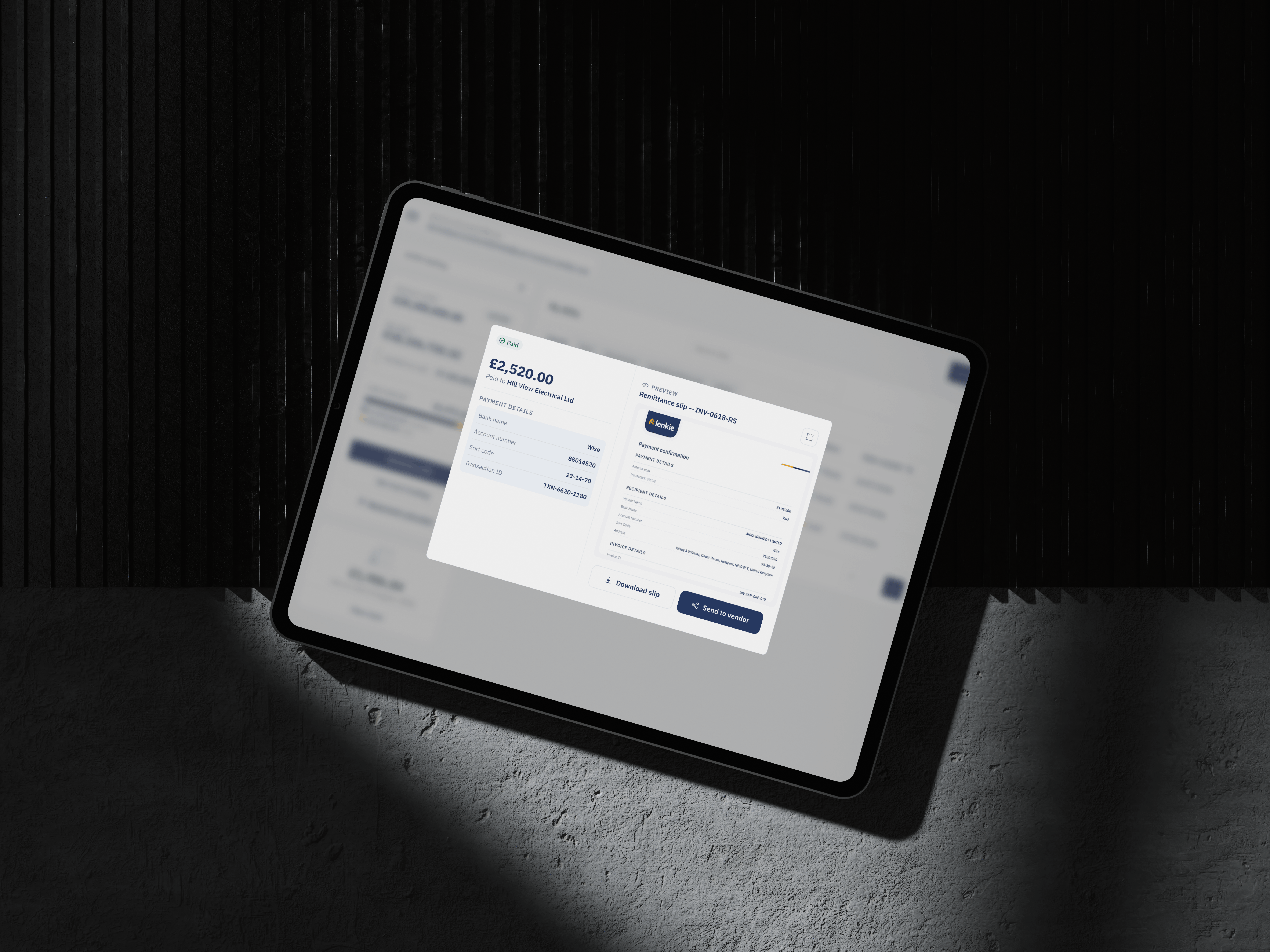
Supplier payments presented an opportunity. Each payment connected a Lenkie customer with another business that might not know about Lenkie. The business proposed branded remittance slips that customers could share as proof of payment, potentially introducing Lenkie to new audiences.
My role
As the sole product designer, I owned the experience from problem framing through design, implementation review and post-launch evaluation.
I translated the initial business request into a customer-focused workflow, explored design alternatives, developed both iterations, and collaborated with the tech lead on implementation and email delivery.

Understanding the problem
The initial request was to use remittance slips to increase Lenkie's visibility among suppliers. Before exploring solutions, I wanted to understand whether customers actually needed them. Conversations with the sales team revealed that some customers had requested remittance slips, while competitor research helped establish their role in confirming payments and reconciling invoices.
This shifted my focus from brand exposure to solving a practical customer need, which I framed as:
"I've paid my supplier. I want them to know they've been paid, without extra work for me."
By addressing this need, we could create a useful payment experience while introducing Lenkie to suppliers naturally.
Exploring the solution
I considered three approaches: automatically emailing slips to customers, making them available in payment history, or presenting them immediately after payment.
I chose the post-payment experience because it offered the most relevant moment to act. Customers could download or share the document without searching their inbox or returning to previous transactions.
I also kept both actions available rather than forcing customers to use Lenkie's email delivery.
First version
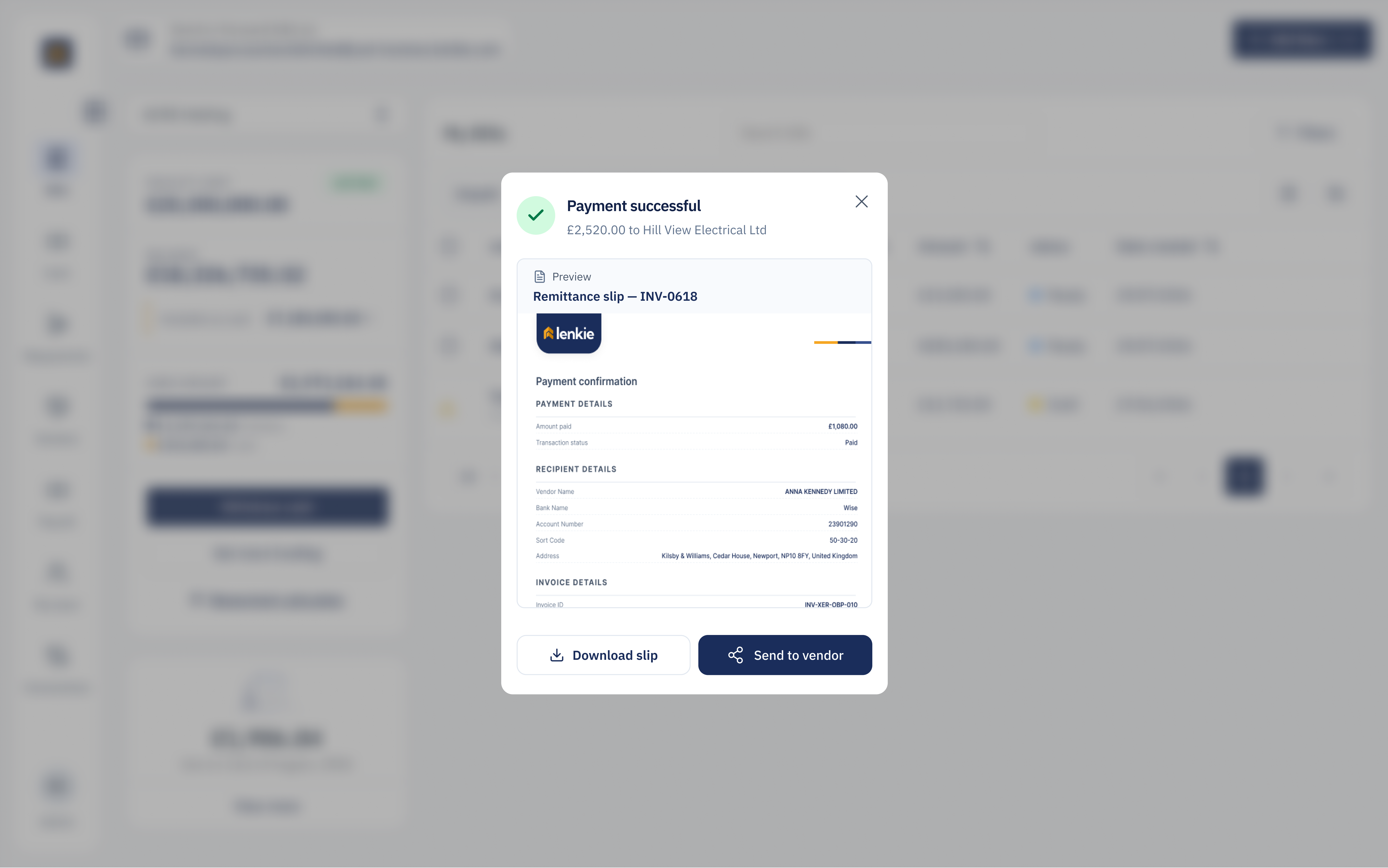
The first version put a slip preview inside the existing payment success modal. It confirmed the payment clearly, with a green check and "Payment successful," and I liked that. But the modal was narrow, so the slip was hard to read at that size. The only payment details on screen were the amount and the recipient. Anything else meant opening the full slip.
Second version
Stakeholder feedback and design review highlighted two distinct needs: customers required a clear payment record, while suppliers needed readable proof of payment.
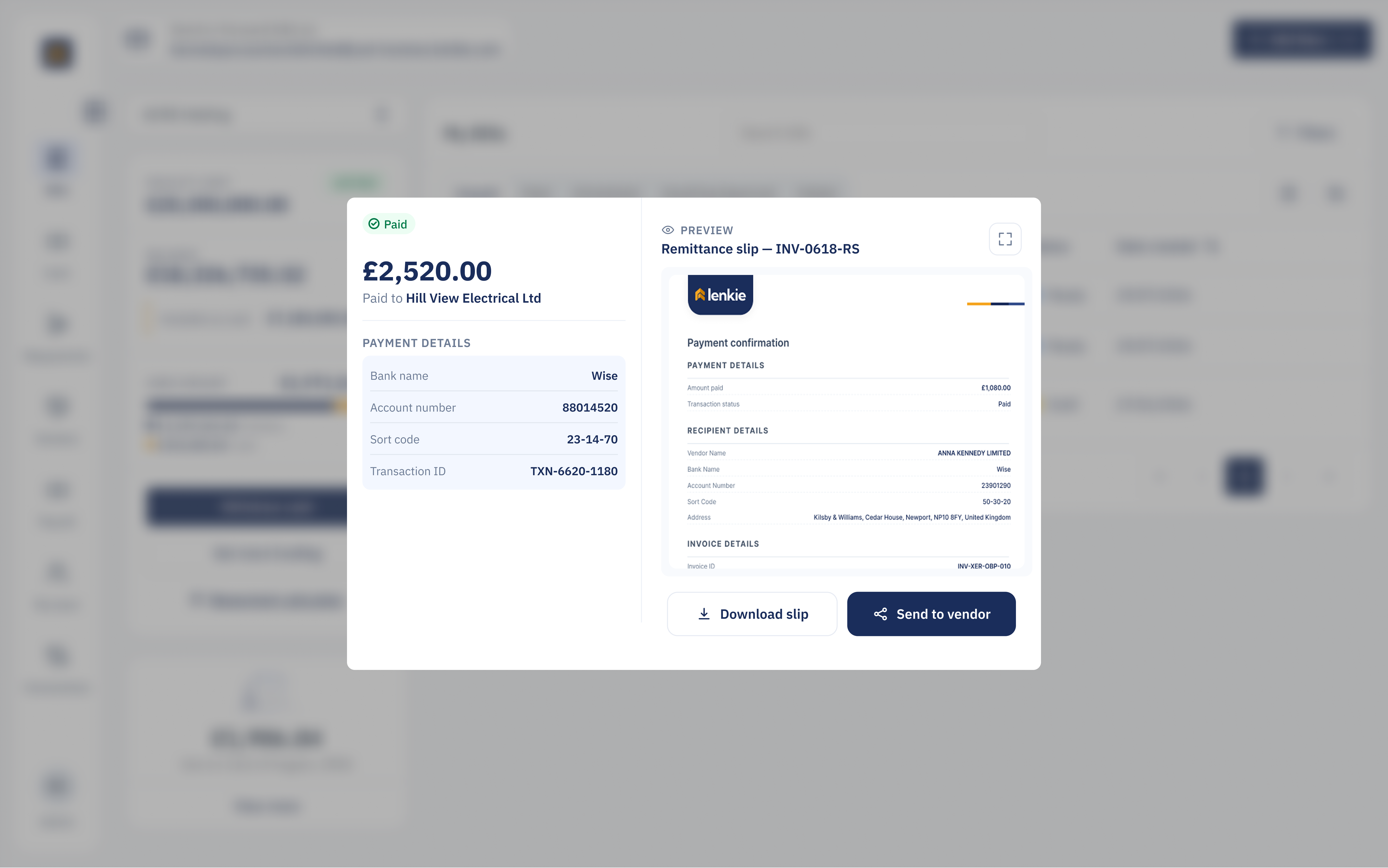
I redesigned the modal into two columns.
The left presented essential transaction details, while the right displayed the supplier-facing slip with download and send actions beside it.
This separation improved the intended information hierarchy and readability, although we didn't conduct comparative usability testing to measure the difference.
| Measure, first 30 days | Result |
|---|---|
| People who saw a slip straight after paying a supplier | 110 |
| Downloaded it within a week | 51 (46%) |
| Sent it to the supplier from the dashboard | 19 (17%) |
| Did both | 2 |
| Different people downloading slips each week | 15 to 23, steady from launch |
| Businesses using it | At least 21, across more than eight sectors |
| Assumption | Verdict | What the data showed |
|---|---|---|
| Customers need slips | Yes, for many | Nearly half of payers downloaded one, and weekly use didn't fade after launch. |
| Email is the workflow | Mostly not | Downloads outnumbered dashboard sends by almost three to one. Most customers take the file and send it their own way. |
| Being seen leads to sign-ups | Not tested yet | Nothing in this version shows what a supplier does after receiving a slip. That's the biggest gap, and the next thing to measure. |
| Trust stays with the customer | Partly | Most customers sent the slip themselves, but 17% were happy to let Lenkie send it. That's more than I expected. |
| It saves work | Partly | People used it steadily without prompting, mostly on a single day each week, which looks like part of a routine. |
What I got wrong, and what I’d change
The shipped slip leads with Lenkie’s logo, while the payer appears below bank details the supplier already knows. That conflicts with my own view that trust should come from the customer. The modal preview also shows Lenkie and the supplier’s details, but not who paid.
I’d put the payer and amount first, followed by the invoice reference and payment date. Bank details would come last as confirmation.
I’d add a short explanation such as “Paid by [customer] using their Lenkie credit facility,” with a tracked link to measure supplier interest.
The Processing state also needs attention: the slip can say “Paid” before funds settle. I’d hold sending until settlement or label it “Payment initiated.”
Downloads were nearly three times as common as dashboard sends. I’d test whether Download should be the primary action, while measuring overall slip use and how many slips reach suppliers through Lenkie.
What I learned
Reviewing the shipped experience revealed three opportunities.
Prioritise the payer's identity. Suppliers need to identify who paid them and which invoice the payment relates to. That information should be more prominent than Lenkie's branding.
Clarify payment status. The document shouldn't imply funds have settled if the payment is still processing.
Investigate sharing behaviour. Downloading was more common than in-app sharing, but we couldn't determine whether customers preferred external channels or encountered friction in the sharing flow.
Measuring success
Before launch, we defined two first-month adoption targets:
40% of exposed users downloading a remittance slip.
30% using the built-in sharing option.
Download adoption exceeded our target by 6.4 percentage points, suggesting that customers found value in accessing payment documentation.
However, in-app sharing fell below target by 12.7 percentage points.
Because customers could download and forward slips externally, we couldn't determine how many suppliers actually received them.
The results supported customer adoption, but didn't validate supplier acquisition.